An evening-walk story: when a husband and wife almost forgot how to talk, until they left their phones at home
Fiction. Hafiz and Farah still sat at the same table every night, but they had not truly talked for a long time. Work, school WhatsApp groups and news on their phones filled every quiet gap. This is the story of how one small argument led them to walk in the park without phones, and slowly brought back something they had almost lost.

A quiet dinner table, even with a full house
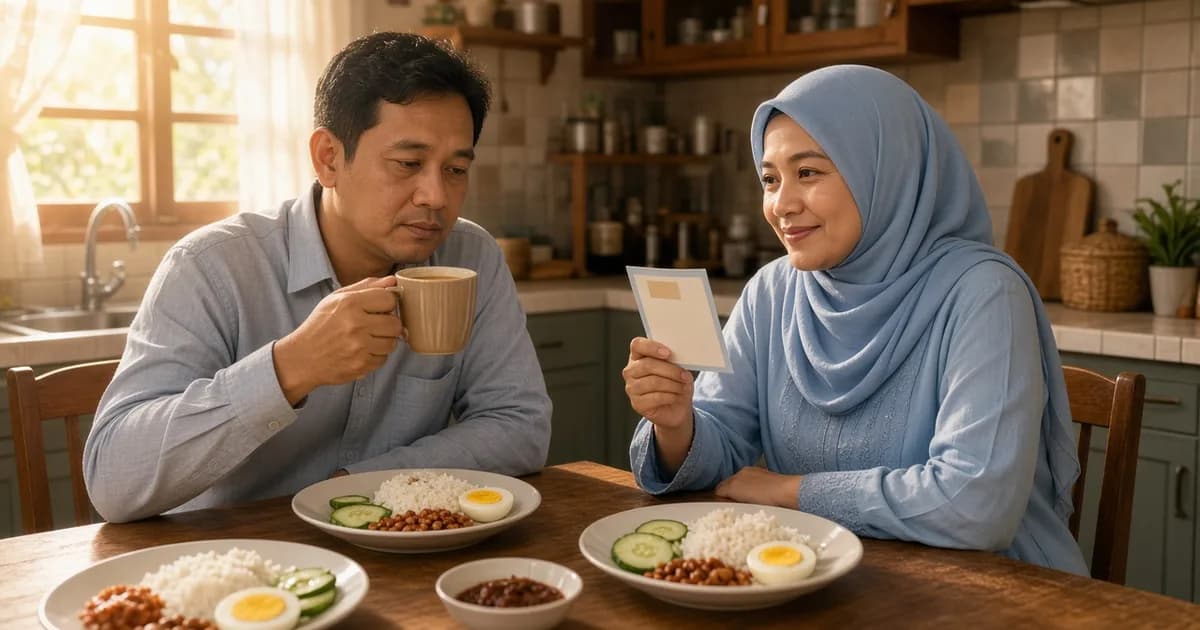
In a two-storey terrace house in Subang Jaya, seven in the evening usually sounded like a small train station. Sofea, seven, repeated spelling for tomorrow. Irfan, four, begged his father to open YouTube. Farah stirred vegetables in a pan while answering messages in Sofea’s class group. Hafiz had just come home from his office in Kelana Jaya, still in work clothes, phone beside his plate of rice.
They ate together. That was still something Farah proudly told her sister. But “together” more and more meant four people at one table, four different screens, and conversation that only appeared when the sambal ran out.
“Abang, Sofea has sports day next week,” Farah said without looking up.
“Hmm,” Hafiz answered, eyes still on an email he had promised not to open at dinner.
“Does ‘hmm’ mean you heard me, or that you’re typing?”
Hafiz looked up. “I heard you. Sports day. Do I need leave?”
Farah put down her spoon. “I haven’t asked about leave. I just wanted you to listen first.”
Sofea looked at both of them, then quietly hid her father’s phone under her exercise book. Irfan laughed. Hafiz did not notice.
A small argument that had been waiting
After the children were asleep, Farah washed the dishes louder than usual. Hafiz knew that sound. He stood in the kitchen doorway, trying to choose a sentence that would not make the night longer.
“Farah, I was tired earlier. It doesn’t mean I don’t care about sports day.”
Farah turned off the tap. “You’re always tired. I’m tired too. But every night you have energy to scroll your phone until midnight. To listen to me, that energy disappears.”
Hafiz drew a breath. He wanted to defend himself. He wanted to talk about deadlines, a boss who messaged at ten at night, and the guilt of missing last year’s sports day. But what came out was shorter and sharper.
“If you think I’m useless, just say it.”
Silence. The kitchen fan hummed. From Sofea’s room came the same rhythm of another fan, as if the whole house was holding its breath.
Farah wiped her hands on a cloth. Her voice was softer, but worn out. “I didn’t say you’re useless. I said we haven’t talked in a long time. Not a meeting. Not about bills. Talked.”
Hafiz looked at the floor. He remembered that before they married, they could sit at a mamak stall late into the night just to talk about small things. Now those small things felt like a luxury they could not afford.
A strange idea: an evening walk, phones left at home
The next evening Hafiz came home a little earlier. Not because he had suddenly become a perfect husband. He simply could not stand the guilt that had followed him through every meeting.
Farah was folding clothes in the living room. Sofea did homework. Irfan napped on the sofa.
“Farah,” Hafiz said, setting two bottles of water on the table. “After Maghrib, let’s walk in the park. Just twenty minutes. Phones stay at home.”
Farah looked at him for a long time, searching for a trick. “Who watches the kids?”
“The auntie next door is around. Or Sofea watches Irfan inside while we just go round the park where we can still see the fence. Or…” he hesitated, “we take them too, but our phones stay.”
Farah smiled a little for the first time since the night before. “You look serious.”
“I look tired,” Hafiz said honestly. “And I don’t want Sofea to learn that husbands and wives only talk when they fight.”
At a quarter to eight, two black phones were placed on the dining table, screens down, like two witnesses asked to keep quiet. They went out with Sofea and Irfan. The neighbourhood park was ordinary: a paved track, rain trees, a few grandparents on benches, and an orange sky slowly turning purple.
Awkward first steps, then softer ones
The first hundred metres felt strange. Hafiz’s hand kept searching for the pocket that usually held a phone. Farah twice almost mentioned the school group chat, then laughed at herself because the phone was not there.
“This feels like leaving the house without a wallet,” Farah said.
“Worse,” Hafiz said. “Without a wallet I can still borrow. Without a phone I have to talk to you.”
Sofea ran ahead, pulling Irfan. The evening breeze carried the smell of freshly cut grass. A makcik smiled at them. “Wah, the whole family walking. Nice.” Farah nodded, a little shy and a little proud.
They talked slowly. Not about the electricity bill. Not about the boss. Hafiz said he had almost fallen asleep in the morning meeting. Farah said Sofea had cried the night before, afraid her father was angry. Hafiz stopped walking.
“I made her afraid?”
“Not monster-afraid,” Farah answered. “Afraid the house would go quiet. She’s good at reading our faces.”
Hafiz looked at the children ahead. For the first time in weeks, his chest felt looser. Not because anything was solved. Only because he was there, not inside a screen.
When they came home, a light sweat on their brows, Irfan was already sleepy on his father’s shoulder. Sofea whispered, “Can we walk again tomorrow?” Farah and Hafiz looked at each other. “Yes,” they said together.
Two weeks later: better sleep, a lighter house
The evening walk became a small routine they announced nowhere. On rainy days they only circled the block once. On days Hafiz came home late, Farah waited at the door with two bottles of water, without nagging. Phones were still needed for work and school, but the dining table got its place back.
Hafiz noticed something he had not expected. He fell asleep faster. Before, after scrolling until midnight, he would lie down with a crowded head and a tight chest. After the evening walks, his body was tired in the right way, and his mind was less noisy.
Farah noticed a difference too. She was still stressed by part-time work and children, but small arguments grew large less quickly. When she needed to talk about something heavy, she waited until after the walk, not while Hafiz was still taking off his shoes.
On the second Friday night, after the children were asleep, Hafiz made less-sweet teh tarik. They sat on the porch. No grand plan. No dramatic promise. Farah simply said, “Thank you for asking me to walk.” And Hafiz answered, “Thank you for coming, even when I sounded like a strange person.”
Under the yellow porch light, the house felt ordinary and meaningful at the same time. Not a perfect house. Just a house whose people were trying to find their way back to each other, step by step.
Tips for couples who have almost forgotten how to talk
The story is fiction, but feeling distant while living under the same roof is common when work and gadgets fill the day. A few things that can help:
- Set a short phone-free time. Dinner or a 15–20 minute evening walk is enough to start listening again.
- Choose a calm moment for heavy topics. Avoid starting sensitive talks when your partner has just come home or is already upset.
- Light movement helps manage stress. Walking together is a simple option that needs no expensive equipment.
- Enough sleep supports mood and patience. Cut screens before bed if you notice they leave you tense or unable to sleep.
- If conflict keeps returning and is hard to handle alone, consider a counsellor. LPPKN offers family counselling, and HEAL 15555 (Ministry of Health) provides mental-health support.
Read also how to communicate with your spouse, how to reduce stress and how to sleep better.
Sources
- The Gottman Institute — How to fight smarter: soften your start-up
- World Health Organization — Stress (questions and answers)
- World Health Organization — Physical activity (fact sheet)
- US CDC — About sleep
- MyGOV — Kaunseling keluarga (LPPKN)
- Majlis Keselamatan Negara — Talian bantuan krisis kesihatan mental HEAL 15555 (KKM)
Fiction. The characters and events are not based on real people. The tips are general information, not medical or professional counselling advice.